
Squeezing the maximum potential of data for chronic patients
CRANE is an EU Horizon 2020 Pre-Commercial Procurement project that developed an integrated self-management model to improve chronic patients’ wellbeing by giving citizens control over their own health data.
Watch the project concept video
Why rural, ageing regions need self-management innovation
Municipalities are vulnerable once more than 19.5% of the population is over 65 — a level industrialised cities are expected to reach within 20 years. This demographic shift is stressing healthcare systems and urging the need for self-management innovation.
CRANE addressed this challenge in three rural areas with more than 30% of the population over 65: Region Västerbotten (Sweden), Extremadura (Spain) and Agder (Norway). In some of these remote municipalities, only 20% of chronic patients can be guaranteed full attention by social service and primary care entities — the remaining 80% need to be empowered to increase their self-control and self-management ability.
These front-running rural regions became testing grounds for sustainable minimum viable solutions that are transferable and scalable to larger city contexts.
Two pillars supporting self-management
Healthcare from home
Adequate monitoring and intervention technology, supported by intelligent use of data to provide actionable interaction with patients, dramatically reducing the need for professional healthcare.
Garden of care
A strong ecosystem of health and social care providers around each patient, tailored to their needs to improve control, safety, security, freedom and wellbeing awareness.
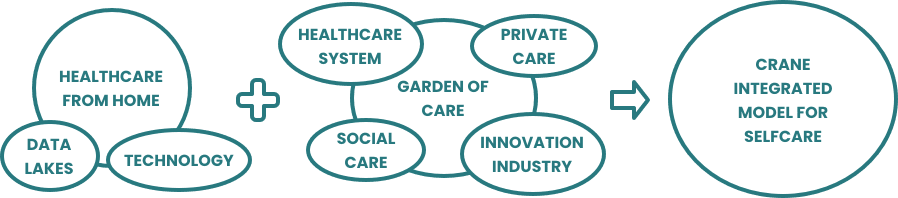
How the model comes together
Citizens as owners of their own health data
Patients gain access, new insight and control of their own health data under GDPR and the European data strategy. Health data has traditionally been tied to the institution that collects it rather than to the citizen — CRANE reverses that, while building trust through transparent, open data policies.
A secure, public-private data lake
CRANE refined a data lake concept applicable to different services as well as research, innovation and development activities, built on the latest encryption technology to keep personal health data secure.
An adaptive garden of care
The ecosystem around each patient — healthcare and social care services, digital literacy, health literacy and motivation — is tailored to their personality and social context, empowering them to take responsibility for their own integrated care model.
A value-based service
CRANE applied an early Health Technology Assessment (HTA) framework across four domains — patient, economic, clinical and organisational — to identify unmet needs, generate evidence, and prepare for value-based service procurement once the project ends.
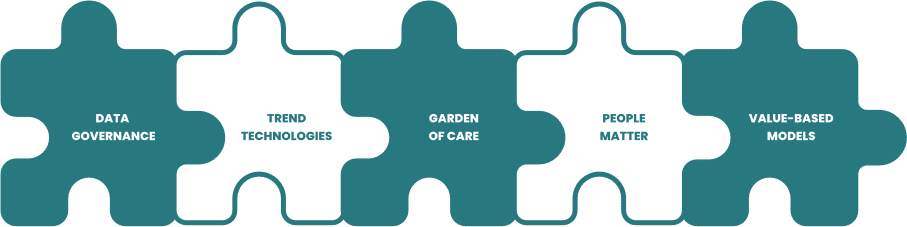
Five pieces, one model
Data governance, trend technologies, the garden of care, people, and value-based models — the five building blocks the CRANE concept is assembled from.
CRANE was not built to implement the European Health Data Space (EHDS) — the European Commission did not propose the EHDS Regulation until May 2022, over a year after the CRANE consortium had signed its Grant Agreement. Instead, CRANE set out, years ahead of that framework, to solve in practice the same problem the EHDS now addresses in law: giving citizens effective control over their health data. The project's positioning paper describes CRANE as “an early, real-world anticipation of the EHDS vision.” See Results for how the two validated solutions align with the EHDS direction.